
Screamin’ in the Rain: The Orchestration of Catharsis in William Castle’s ‘The Tingler’
Full of brash ballyhoo, tricky gimmicks, and plenty of cinematic hokum, director William Castle’s low-budget “shocker” films seem to lie somewhere far beyond—or beneath—criticism. Indeed, as one writer once aptly put it, “to search deeper into [Castle’s] productions for obscure messages is critical pretentiousness of the first order” (qtd. by Brottman 6).
However, whether due to critical blindness, or willing avoidance, the notion that Castle’s films are somehow beyond criticism is a sure sign of a powerful cultural myth at work in regard to the “untouchable” value of Hollywood entertainment.1 Indeed, I will risk “critical pretentiousness” by going so far as to claim that Castle’s oeuvre mythologizes the cinematic pleasure of the horror film as a socially-ordained ritual for catharsis, especially in the way that he frames the extra-diegetic theater space as a kind of interactive carnival attraction. In his film, The Tingler (1959), which literally induces screams (using vocal cues from the actors, signals from “plants” in the audience, and joy buzzers in the theater seats), the structuration of film as catharsis is made manifest in highly self-reflexive ways that become a sort of ideal, and therefore, ideologically loaded, model of the film medium itself. The Tingler overtly treats the theater house as a participatory “funhouse,” in which film generates not terror, per se, but a collective catharsis, or release, through loud yelling in a public gathering space. In the process, it masks the mass media ideologies that manufacture and construct its pleasures. Inasmuch as horror cinema seeks to sadistically “shock” audiences, it also seeks to create a festive, communal atmosphere in the theater through the shared discourse of the scream. The participatory discourse of this scream can mean and express many things—from rage to terror to orgiastic pleasure. Its multivalent, non-verbal, or even “primal” potency gives the scream experience its power—it is a generalized, anonymous presence, combining a multiplicity of voices, surrounding the spectator in the darkness, validating and encouraging self-expression free of self-consciousness. Instead, it provides a kind of collective existential rage against fear or a vocalized defiance against the inevitability of death. However, while communal screaming can serve a liberating and even cathartic function for audiences, the marketing of the horror film theater as a “funhouse” serves to ultimately commodify the experience into a ritual by treating the cinema as a sort of “folk art” rather than the profit-driven mass media stimulant that it often is.
In many ways, horror films seek to make the theater space as interactive as a Hollywood musical, and it is in the unlikely area of musical criticism where similar issues have been explored. In “The Self-Reflexive Musical and the Myth of Entertainment,” Jane Feuer explains how self-reflexive films (or “movies about the movies”) affirm their own value for the popular audience by baldly appropriating the tropes and methods (and implicitly, the authenticity) of folk art. Classic Hollywood musicals, which almost always seem to be about making musicals. Especially evident in “backstagers” ranging from 42nd Street (1935) to The Producers (2005), many musicals comment inwardly as a means toward perpetuating the idea that cinema is the medium that best provides the pleasures endemic to its genre (as opposed to, say, the radio or the stage, with which they are in competition). They also demystify film production by exposing backstage elements, only to re-mythologize the practices that it would otherwise expose. As Feuer puts it, “self-reflective musicals mediate a contradiction between live performance in the theater and the frozen form of cinema by implying that the … musical is theater, possessing the same immediate and active relationship to its audience”. As such, they have the power to break down the cultural barriers between high art and everyday life (453). The self-reflexive nature of this genre reifies and perpetuates the myth that the mass audience, rather than the dominant mass media, are in control of this experience, confirming a sense of genuine realness to what is ultimately an artificially constructed ceremony.
In what follows, I want to explore these claims by applying them to the self-reflexive films of another popular genre, horror, using the campy creature feature, The Tingler as a central test case. I will suggest that the self-reflexivity in William Castle’s most ballyhooed film likewise functions not only to perpetuate Feuer’s myth of entertainment, but also to mythologize the pleasures of horror film for its audience in particular ways. Specifically, I want to examine the carnivalesque manner in which the cinematic theater becomes a funhouse for recreational terror, a construct of catharsis, even though it is not a funhouse but a more passive spectatorial experience—just as the musical genre often treats the cinema house as a music hall, which it isn’t.
Screamin' in the Rain
How can The Tingler—a post-atomic horror film about a lobster-like creature that manifests on your spine whenever you are afraid—possibly be compared to something as life-affirming and fancy-free as a musical? If we set aside genre and look at the form and content of both The Tingler and another self-reflexive picture from the same decade, Singin’ in the Rain (Donen and Kelly, 1952), the correspondences between the different genres are fascinating.
First, both films not only positively represent film itself within the narrative proper, but also comment on outdated cinematic technologies (such as in silent pictures) in order to celebrate and reify their own advances in technology (such as color). In response to the breakdown of the studio system in the wake of the HUAC hearings—when average theater attendance had dropped 63% (Sklar 344)—and the loss of faith in the “undiluted positivity” of post-wartime musicals (Wells 58)—both films were typical Hollywood fare in that they used the tactic of luring audiences into the theater by highlighting escapism and promising new cinematic pyrotechnics that put that new competitor, television, to shame. In The Monster Show, David Skal writes that “Castle’s gimmicks were part of the larger Hollywood movement in the fifties toward expansive presentational modes that could compete with television” and iterates such items from this trend as “CinemaScope, 3-D, Cinerama, stereophonic sound, and even the short-lived process called Smell-o-Vision” (259). For Singin’ in the Rain, it was the brightly saturated hues of “Technicolor” and the advances in stereophonic sound that were made immediately present by the musical; for The Tingler it was Castle’s concept of “Percepto!”—a gimmick that ambiguously referred to both the surprising use of color film stock during a nightmare sequence in the middle of what was otherwise a black-and-white film and the now-famous use of vibrating buzzers installed under theater seats to literally “shock” the audience in sequence with the film’s most frightening scenes. Such marketing of technological progress commodifies the theater space; in it, technology merges with text to become part of what you are buying when you get a ticket to the screening event. In this way, the movies (via technology) become mythologized as virtually supernatural in power, as a sort of “magic” place of “escape.”
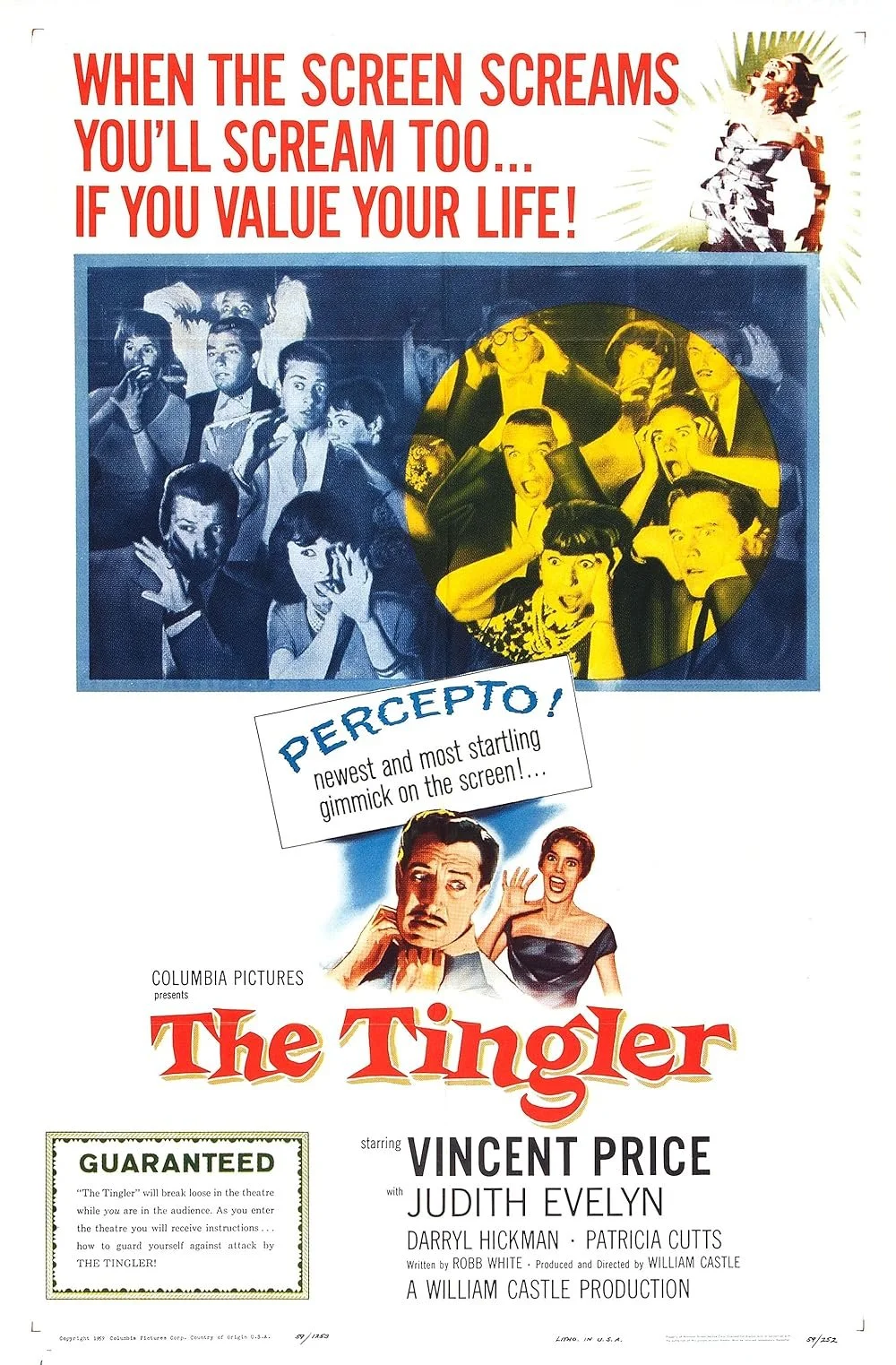
One-sheet poster for The Tingler (1959), promoting “Percepto” gimmick.
But even as they reify and mythologize their own use of technology, these films at the same time also demythologize the cinematic technologies of the past as a way of asserting their own claims to offer a new and stronger cultural power, especially in terms of sound. Just as Singin’ in the Rain retrospectively comments on the failures of the move from silent pictures to the talkies, so, too, does The Tingler look back at the silent screen. Obviously, much of Castle’s film is set in a “silent movie house” which becomes the “dark place” for an eruption of horror when the titular creature breaks loose. But more importantly, the failure of characters to modernize and adapt to new technologies is allegorically punished and overtly parodied in both films. Consider how silent movie star Lina Lamont’s (Jean Hagan) career is killed by her inability to speak or sing properly in Rain. The comedic pitch of her voice contradicts the smooth melodies of Kathy Seldon (Debbie Reynolds), whose voice eventually overdubs Lamont’s as it is broadcast from behind a curtain in the film’s final “outing” of Lamont as a fraud. (This “voice behind the voice” harkens back, too, to MGM’s most successful musical, The Wizard of Oz, which self-reflexively heralded another technological shift, from black-and-white to color—in a manner that is echoed in Castle’s film during Mrs. Higgins’ nightmare sequence.) In the process, a mockery is made of those who can’t “upgrade,” so to speak, to the new technology. Debbie Reynolds’ voice is framed as not merely more talented or aesthetically pleasing than Lamont’s, but more authentic because she can easily adapt to the new medium of the talkie. In contrast, Lamont is shamed and punished for her inability to convert to the new medium.
Like the tone-deaf Lamont, the deaf-mute “throwback” character of The Tingler, Martha Higgins (Judith Evelyn), dies because of a failure to master her own voice. Indeed, according to the film’s vulgar Freudianism, if one cannot cathartically release their pent-up “fear tensions” by belting out a scream, then the titular creature will not merely “tingle” but strangle and snap one’s spine. Because Higgins is mute, she dies when she encounters the image of a blood-red hand that emerges from a bathtub full of blood. Ostensibly her inability to vocalize her scream of fright is what gives the creature inside her the power to snap her neck. Not screaming kills her, and this serves as a sort of warning to the actual audience, who will later be directly told they must “scream for their lives” by Dr. Chapin (Vincent Price) at the climax of the film. It is telling that during this entire nightmare sequence with Higgins, only the real film audience can hear the creepy sound effects and old-time music syncopated to Higgins’ mime-like acting (since she is deaf). The scene has all the trappings of a silent movie for the audience, while at the same time juxtaposing Higgins’ miming against the film's flaunted new “color” technology when a bloody red hand clutches at her as it emerges from the water in her bathroom tub.

Just as the novelty of the new mocks the silent film era and symbolically tortures and murders the stars who are beholden to outdated media, The Tingler also pokes fun at the limitations of black-and-white film art. During Higgins’ hallucination, only the audience can see the color red in contrast to the black-and-white film stock, since Higgins presumably already sees her world in color anyway. The color is an extra-diegetic perception, an irrationally expressionistic suggestion of hallucination, one only made possible by advances in film technology at the time, harkening back to Dorothy’s dream vision in The Wizard of Oz. It is as though, at the moment of highest horror, a color blindness throughout the film is “magically” erased.
Moreover, just as the silent performance of Higgins’ death by fright is akin to a silent screen character being tortured and murdered, later in the film the victim becomes the silent screen itself. In the climax of The Tingler—its grand Percepto moment—a silent picture, Tol’able David (1921), takes over and occupies the frame for a few minutes only to be torn as the shadow of a lobster-like Tingler creature crawls across the white screen. It is suggested that this monster literally eats up the old film. The “screamfest” that subsequently erupts in the film’s film—in the implied diegetic space of the imaginary theater in which we are viewing the torn screen—then merges with the real movie house space of the spectator, as Vincent Price’s character in voiceover urges both audiences, real and represented, to scream for their lives. In this theatrical dismemberment of Tol’able David, where Price’s “voice” encourages us to vocalize in a battle against the silhouette on screen, we are given not simply an attack on silent cinema technology, but also an attack on “classic” Hollywood film in toto by a hyper-realized moment of genre expressionism. It’s as if we are being asked to both disrupt the ordered space and enjoy its destruction. A violence is done to cinema history, too, as Castle (perhaps unconsciously) seeks to obliterate the silent worship of the popular and polite texts of the past under the carnivalesque screams generated by the new rubber pincers of a Tingler.
Those screams, in my view, are as interactive as any song in a musical that encourages its audience to sing along. Singin’ in the Rain, for instance, incorporates songs from previous Freed musicals; in fact, Rain actually strings together a series of remakes of old musical numbers from the silent age, which the audiences in its time might have recognized and hummed along to. Both films persistently invite us to interact through such direct address. Just as Gene Kelly cries an imperative, “Gotta dance!” in the culminating moments of Rain, so too does Vincent Price urge the audience to, “Scream for your lives!” in The Tingler. The audience knows it is not threatened, but by responding to the plural command (“your lives”) the audience forges a pleasurable communal bond by screaming, just as they might do by singing or tapping their feet.
Ultimately, in both cases, these exemplary genre films directly “tingle” the senses as a way of suggesting that new cinematic and theatrical technology are better than those of the past and that experiencing this spectacle as we might in a carnival attraction or music hall. Rather than following a narrative as we might while reading a book, it is why we go to the movies in the first place. Screen entertainment is thereby equated with the jouissance of physical titillation (a scream, a song) which ostensibly provides catharsis in the same way in which a tickle might generate a laugh. In this way, theater attendance becomes a form of not merely consumerism but a collective fetishism of film technology (movie “magic”), rendering any narrative meaning secondary. This remythologizes new film technology as powerful in its novelty even as the familiar and time-tested narrative scenario crushes representations of other, older, less titillating film forms underfoot.
Three Myths of Entertainment
But Hollywood’s myth of entertainment usually spars with media other than just itself. Feuer identifies three primary myths that are perpetuated by the film musical genre which allude to the immediacy of the stage: the myth of spontaneity (pleasure is characterized as an organic eruption of emotion), integration (forging bonds with social groups is characterized as achieving wholeness), and audience (in which the emotional relationship of spectators to cinema is rewarded by the film). Analysis reveals that these same theatrical myths also underpin Castle’s horror film, if not all horror films.
In the musical, the myth of spontaneity for Feuer is marked primarily by rupturing the narrative with a sudden song and dance number (a rupture so familiar that it was later parodied in Monty Python and the Holy Grail (1975): “…but father, I just want to sing!”). The horror film’s analogue is the scream, which spontaneously erupts whenever threats, perceived or imagined, are imminent. I’ve already discussed how screaming dominates the plot of The Tingler, but it’s worth noting that the element of surprise—which is traditionally aligned with electricity in the form of a perceived “shock”—is the trigger of an audience’s scream, as if the body were a machine. Indeed, the Tingler creature itself “spontaneously” forms on the spine, manifesting not only spine-tingling fear but also symbolically attributing that fear with supernatural power. It’s “as strong as steel,” Price’s Dr. Chapin says at one point in the movie, “probably stronger.” Likewise, Price’s modernized mad scientist figure, while generally staid in demeanor, is the master of all surprise in the film, and in some ways Dr. Chapin is the threatening monster for the film’s first half, overreaching the boundaries of sober scientific ethics in order to discover more about the Tingler.
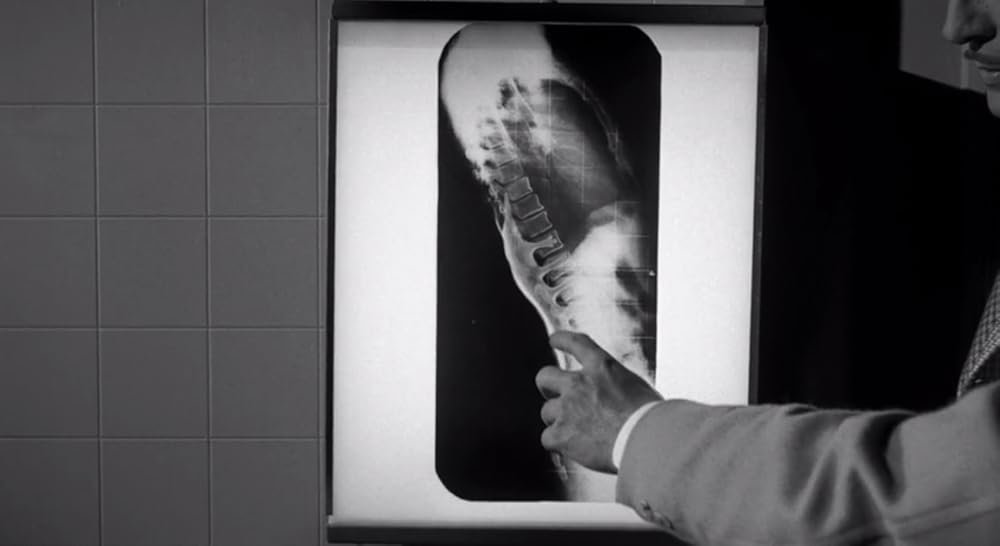
Dr. Chapin proves the existence of “The Tingler” in The Tingler (1959).
As a way to test his hypothesis about the Tingler’s existence, Chapin “surprises” his cheating ex-wife by firing a blank pistol at her; after she faints, he x-rays her spine and in the radiograph (itself also a black-and-white film) finds proof positive of the spine-gripping creature. Afterward, he masochistically injects himself with some LSD that he happens to own at the spur of the moment when he wants to feel what it is like to have a Tingler inside you: “The only way I can frighten myself,” he says, uttering a subtle commentary on the mythic function of all horror cinema, “is to make it real.”2 This reality is treated not as the work of planning but of spontaneous bricolage, where performers make use of props at hand, just like Gene Kelly might conveniently use an umbrella that happens to be handy as part of his dance routine. The shocks and the screams of the horror cinema, likewise, emerge spontaneously, and therefore “naturally,” from the mise-en-scène as much as the character’s body; the scripted and programmed work of the cinema is framed as organic, capable of spontaneous eruption, in the process. In fact, here the repression of spontaneity—holding back a scream—is what is characterized as unnatural and abnormal, if not monstrous and fatal.
Along these lines, normalization occurs within the second myth that Feuer articulates in self-reflexive musicals: the myth of integration. In the musical genre, individuals integrate into social bonds via romantic coupling and synchronized dance routines that suggest that coordination and partnership are not only important social values, but organic, humanistic values that film media ideally affirms. In The Tingler, social integration is implied both through the representation of coupling and the dynamism of the audience’s response to “Percepto.”
The use of romantic pairings in The Tingler bears study because the film doesn’t follow the Classic Hollywood Narrative paradigm, which would normatively celebrate the union of a hero with his love interest. Price’s Chapin and his wife, Isabelle (Patrica Cutts), are a broken couple throughout the film. Price sadistically frightens his wife against her will, making her his test subject. Isabelle, in revenge, sets the Tingler loose by his bedside in an attempt to murder him before she runs away. In fact, she becomes a puzzling loose end in the film, never to return. Likewise, as a sort of double for Dr. Chapin3—who is himself a double for William Castle—Olly Higgins (Phillip Coolidge) tortures his deaf-mute wife, Martha, into “death by fright,” which ultimately manifests the Tingler. But the Tingler never attacks Olly directly; if it is the return of his repressed, it never really returns to him at all. The principal characters in The Tingler’s drama are couples that never connect.
In contrast to these “bad couples,” Price’s lab assistant David and his sister-in-law, Lucy (Darryl Hickman and Pamela Lincoln), are engaged to be married, and represent a certain clichéd heterosexual norm in contradistinction to the failed and murderous marriages of the Chapins and the Higginses. But, surprisingly, this teen pair is never directly threatened by the Tingler and neither David nor Lucy emerge as heroic protagonists in the plot. Instead, they are merely vigilant and concerned witnesses to Dr. Chapin’s mad experiments. When Price drops acid to frighten himself into producing a Tingler (and failing), they watch helplessly from behind the laboratory window, commenting on his “performance” of a bad trip. Just as they witness it, so, too, do we as spectators: the self-reflexivity of the moment invites the audience to identify with the young couple. And this explains their narrative function, for David and Lucy are, in fact, stand-ins for the teenage couples who ostensibly are the target audience for the picture, and very likely were the dominant theatergoers at the time of its screening.4
This representation of a teen couple in the audience is later echoed in the “Percepto” sequence itself, when the Tingler is set loose in the silent theater house. The sequence begins by showing us an anonymous teen couple in the seats: a young woman nervously chomps popcorn and studies the silent film in deep concentration, fending off the repeated attempts of the boy who sits beside her, trying to make out. The girl moves to a new seat to better enjoy the picture, only to then be attacked physically by the Tingler, who climbs up her leg—and it only lets go when she screams—which in turn launches pandemonium in the theater represented on screen (and ceremoniously initializing the funhouse screamfest that would occur in the audience proper).5 In this particular scene, the “tingler” is clearly a vulgar Freudian metaphor for repressed sexual desire, which is sublimated into an orgasmic scream that is publicly exhibited, celebrated, and sanctioned by Price’s encouragement for all movie patrons to scream for their lives. Nay, this sexual repression is even physically released by the vibrators that Castle notoriously placed under the seats during the initial screening of this film, delivering the “Percepto” gimmick through a literal tingle by theater mechanisms aimed at stimulating a haptic sensation.

“The Tingler” attacks audience members in the on-screen theater, prompting the “Percepto” gimmick in the live audience. Image via IMDb.
Regardless of whether or not the film services psychosexual needs or simply releases pent-up anxiety generated by the film itself, The Tingler clearly constructs a narrative of catharsis via screaming, all of which supports Feuer’s third myth of entertainment: the myth of audience. By giving spectators a collective sense of participation in the performance, the theatrical exhibition of film becomes a “funhouse” that suggests an organic and carnivalesque folk art is in operation when, in fact, everything is a consequence of mass media entertainment and the manipulations of its corporate technology.
Mass Catharsis as Entertainment
In the conclusion of her study of musicals, Feuer claims that these genre films “mediate a contradiction between live performance in the theater and the frozen form of cinema by implying that the … musical is theater, possessing the same immediate and active relationship to its audience” (453). I've suggested that horror’s antecedent of “live performance” is the circus “funhouse,” and Castle-the-showman is like the P.T. Barnum of the cinema.6 But it might be more appropriate to say that his approach harkens back to the technical showmanship and ballyhoo surrounding the Grand Guignol theater—literally, the “Punch and Judy” puppet show made large on stage in fin-de-siècle France (Gordon 14)—which sought to set aside all pretenses toward story and create a “pure theater” of effects in the name of shock.
In the Grand Guignol theater, stage tricks made gory bodily spectacles present and “real,” with actors simulating bloody stabbings and beheadings in much the same way a magician might “realize” his fantastic performance of a miracle. Castle’s ballyhooed films transplanted the pyrotechnics of the stage trick from the stage into the technological medium of film, “realizing” the supernatural in much the same manner as the Guignol: by tricking the eye, and in the case of “Percepto,” the skin and the ear, as well. David Skal cites Castle’s own description of the “total sensory immersion” he would want for “the ultimate gimmick”: “The audience would taste the fog drifting through a cemetery. They’d smell the freshly dug grave. They’d feel the touch of ghastly fingers” (259). While one could make this claim to realism for any gory use of special effects, Castle’s highly theatricalized use of gimmicks goes far beyond any visual or sound effect, spilling into extratextual space. The horror film—itself literally a “tingler” (short for “spine-tingler”)—sought to stimulate the bodies of its audience by tickling their backsides with buzzers, coaxing people to “scream” not only on command but by modeling this performance through the use of “plants” in the audience, some of whom added to the audience’s hysteria by pretending to faint in the rows. Whether audiences were “afraid” of the Tingler creature or not is somewhat moot—almost their entire sensorium was prodded into uttering a scream and the act was usually contagious due to these tricks which spilled off the screen and entered the theatrical space, bringing with it, as William Paul explains, a “communal experience, a festive feeling akin to drunkenness” (Paul 67). By turning the filmic event into an active, participatory experience akin to a thrill ride at the carnival, Castle was implicitly making the artistic argument that the horror cinema is a modern Grand Guignol.7
At root, what the Grand Guignol, which Mel Gordon calls “the most Aristotelian of twentieth-century dramatic forms… devoted to the purgation of fear and pity” (2), shares with Castle’s films is the paradigm of catharsis; that surprising representations of violence and fear can cathartically release pent-up violent urges or anxieties. The Tingler, by participating in this tradition and reproducing a narrative centered on the notion of catharsis—of purging “fear tensions” through screaming or engaging in a sort of “psychic cleansing”—reifies the cathartic function of horror cinema.
In her fascinating article about this film, “Ritual, Tension, and Relief,” Mikita Brottman discusses how The Tingler offers catharsis as a “popular secularization of Freudian psychoanalysis” rather than a matter of fact (9). The creature in the film is a free-floating signifier, more ambiguous than any “repressed impulse waiting to return” and Brottman sees it as more physically abject—calling the creature a “faecal double” rather than a “repressed impulse waiting to return,” (10). Brottman’s case is convincing, but I would suggest that she’s engaging in something of a false dichotomy: whether the film truly provides catharsis or not is moot because it is not the text which provides the catharsis but the ritualized public consumption of it in a collective, carnivalesque manner. Carnival is liberating, as Bakhtin and the numerous cultural critics that follow him have articulated, because it allows for “the ‘low’ to insist upon its rights to a place in the culture…a world without rank or social hierarchy” outside officialdom, in the form of playful creative freedom (Fiske 82). As much as The Tingler belongs in a tradition of carnival, it also is modern in both character and medium. Castle technologized catharsis and commodified the conventions of the funhouse into a packaged ritual—cinema—in order that audiences would return to the theater again and again.
That these tropes are myths cannot be disputed. Just as musicals don’t really replace the interaction one has with actors during stage performance, horror films don’t really engage in the immediacy and trickery of the Grand Guignol or the circus funhouse. They are shells of projected light and amplified sound, echo chambers for pre-recorded material. Their technology replaces the human voice behind the music—and no one dies in a horror theater, whether they scream or sit silent. The machinery of the theater and the lack of true interaction with the screen actors do not make them lesser texts, but they do not fully replace the human presence on the stage. The projection of the Tingler’s shadow on the screen is just that: a play of light that pretends there is presence where there is only absence. In an effort to hide this fact, to enable us to suspend disbelief, film trains us to believe in its power by repeating these myths as formulae, again and again. Films reify their consumption as cinema in the stories they tell about themselves and the manner in which they tell us these stories. But as much as the funhouse is structured to mechanically induce reactions, we need to remember that it is the spectator who is the main performer in her own ritualized social theater.
The strength of Hollywood’s myth continues even when theater seats are no longer rigged and theater attendance has waned in the era of home video, internet streaming, and Blu-ray discs. Although the self-reflexivity of horror is often subtle, the myth of horror entertainment reappears quite strongly in forms ranging from the postmodern parody of Wes Craven’s Scream trilogy (1996-2000) to the 25th Anniversary re-release of The Rocky Horror Picture Show (1975) on disc. Movies like The Blob (1958/88), Popcorn (1991), Gremlins (1984), Matinee (1993), Scream 3 (2000), and many others incorporate images of “terror in the aisles” in direct and indirect homage to Castle, reifying the myths that have been the subject of this essay. No one rigs the seats anymore (it’s probably illegal, or at least a bad idea) but every horror film presents itself as a “tingler,” mythically promising to purge your fears—and thereby save your health—if only you’re willing to scream. The degree to which we buy into this myth and engage in horror cinema as social ritual dictates the degree to which horror succeeds as entertainment.
One might argue that Castle’s gimmicky methods are throwbacks to a form of cinema that is long dead, or that his “funhouse” cinema is so superficial as to be undeserving of critical thought, but I would humbly suggest that those critics go “ride the movies” at theme parks like Universal Studios Orlando, and listen to the passengers scream, to realize just how much Castle’s carnivalized theater, and the myth of entertainment has escalated in order to become one of the dominant, most profitable, myths of our time.
Notes
1. In Laughing, Screaming, William Paul inquires into why gross-out horror films and comedies are often not critiqued: "…explaining a pleasurable dream is not comforting because the explanation itself brings on a disturbance. In effect, we would like comedy to be meaningless because we would often rather not know what we're laughing at" (69). Freudian theorists call this "disavowal." ↩2. This scene in the film is purportedly the first appearance of LSD use in US film history. Sean Axmaker writes: "Chapin…has the first acid-trip freak-out on American screens. Price hams it up with gusto, but apparently no one on the production had any actual experience to draw from, and his histrionics make the scene endearingly square in retrospect." ↩
3. It must be noted that the plot's logic implies that Chapin has induced the hallucination that Mrs. Higgins experiences by injecting her with LSD; only near the film's conclusion do we learn that Olly was responsible for orchestrating the events. ↩
4. Musicals accomplish this in similar ways, typically by showing theatrical audiences in the films themselves who applaud or boo the musical numbers. Feuer also mentions "natural, spontaneous audiences that form around offstage performances" in the narrative, or the uses of intertextuality, star iconography, and songs that audiences know from previous stage musicals (452). ↩
5. Phenomenologically, seeing the portrayal of screaming seems to catalyze screaming in audience in much the same way as a laugh track stimulates audience chuckles: "While comedies don't usually show actors laughing and while melodramas seem to work best without lots of on-screen sobbing, horror movies dwell insistently on people screaming. They seem to have perceived that scary situations are not enough to frighten audiences; we also have to see people in the movie widening their eyes in terror and stuffing the backs of their wrists in their open mouths [a la Vincent Price's LSD experiment]…scary movies are not about monsters, they're about scared people" (Bernstein). ↩
6. Castle's analogue might be Max Maurey. In his history of the Grand Guignol, Mel Gordon emphasizes Maurey's commercialistic exploitation of audience's desire for a "slice of death"—he "sought sure-fire formulas of terror and fear…pure theater…where horror was to be immediate and physically shocking, even sickening" rather than an act of experimentation for art's sake (18). The director was a master of ballyhoo, who would use fainting "plants" in the audience, just as Castle did with The Tingler (where a woman would faint and be carried out of the theater on cue). ↩
7. Mikita Brottman notes that French critics of the Cahiers du Cinema called The Tingler a realization of the "'happening-cinema' conceived by the Futurist movement: a system of traumatization, 'where the spectacle unfolds not only on the screen, but also in the room, with special effects that allowed the audience to be played with like puppets'" (6). I would counter-argue that such traumatization was nothing 'futuristic' at all—as such "play" was literalized years prior in the Grand Guignol. Moreover, the low budget effects of Castle's film rely more on bricolage—of making use of what's already in the theater (the seats) rather than technologically overhauling the entire screening event, as they do currently in Universal Pictures amusement park.↩
-
Axmaker, Sean. Review of The Tingler, directed by William Castle. Turner Classic Movies, 16 Nov 2003, https://www.tcm.com/tcmdb/title/19997/the-tingler#articles-reviews?articleId=185031. Accessed 26 Oct 2024.
Bernstein, Barbara. Review of The Tingler, directed by William Castle. Movies-seivoM: The Self-Reflexive Movie Database, 20 Oct. 1995, www.kinexis.com/movies/the_tingler_[1].html. Accessed 15 Oct. 2003.
Brottman, Makita. "Ritual, Tension, and Relief: The Terror of ‘The Tingler.’” Film Quarterly, vol. 50, no. 4, Summer 1997, pp. 2-11.
Castle, William, director. The Tingler. Columbia Pictures, 1959.
Donen, Stanley and Gene Kelly, directors. Singin' in the Rain. Turner Entertainment Co./MGM, 1951.
Feuer, Jane. "The Self-Reflexive Musical and the Myth of Entertainment." In Film Genre Reader III, edited by Barry K. Grant, University of Texas Press, 2003. [Originally published in Quarterly Review of Film Studies 2.3 (1977)].
Fiske, John. Understanding Popular Culture. Unwin Hyman, 1989.
Gordon, Mel. The Grand Guignol: Theater of Fear and Terror. Revised Edition, DeCapo Press, 1988.
Paul, William. Laughing, Screaming: Modern Hollywood Horror and Comedy. Columbia University Press, 1994.
Skal, David. The Monster Show: A Cultural History of Horror. W.W. Norton, 1993.
Sklar, Robert. Film: An International History of the Medium. Prentiss-Hall, 1993.
Wells, Paul. The Horror Genre: From Beelzebub to Blair Witch. Wallflower, 2000.
Article by Michael A. Arnzen
Michael Arnzen (gorelets.com) is a Professor of English and the Assistant Director of Writing Popular Fiction at Seton Hill University, in Greensburg, PA. Known primarily for his focus on the horror genre, his film criticism has appeared in numerous journals (including The Journal of Popular Film and Television, Narrative, Paradoxa, and Jump Cut), and such academic books as The Exorcist: Studies in The Horror Film and The Films of Stephen King. As a creative writer, to date he holds four Bram Stoker Awards for his novels, short fiction and poetry, which includes such titles as Proverbs for Monsters, 100 Jolts and Grave Markings. He recently began a short-form podcast on all things horror you can listen to at 6m66s.com
Other Articles You May Enjoy…
Within Filipino folklore, no creature captivates and horrifies like the viscera-sucker, or manananggal. In Ramos’s taxonomy of aswangs, they are typically portrayed as beautiful women with long hair who, by night, split at the waist and detach from their lower body, hiding it in a safe place, such as under a banana tree. The top half sprouts wings and takes to the night to hunt for prey, intestines flying behind her.