
The Dream-Shadows of David Lynch: An Interview with Lindsay Anne Hallam
In the realm of horror, the dreamlike and the surreal, as much as ghosts and gore, all have a role to play in exploring our internal worlds and fears. Both the names “Lovecraftian” and “Lynchian” are equally evocative for very different reasons—H.P. Lovecraft for cosmic horror and David Lynch for the dreamlike quality he brings to his work in both television and film. Lynch’s work, including Twin Peaks and Mulholland Drive, among many other highly acclaimed pieces, has left an indelible mark on the subconsciousness of pop culture, and has continued to challenge writers, filmmakers, and many other creatives to rethink what their respective artforms are truly capable of.
Dr. Lindsay Anne Hallam, a senior lecturer in film at the University of East London, has dedicated much of her research to Lynch’s work, including publishing the book Twin Peaks: Fire Walk with Me for the Devil’s Advocates series, which is dedicated to in-depth film analysis from field experts. Hallam’s work also includes the keynote address “Dreams of Dark and Troubling Things: David Lynch as Horror Auteur” and the essay “Women's Films: Melodrama and Women's Trauma in the Films of David Lynch,” among other fascinating titles. Hallam, with her Ph.D. in Media and Information from Curtin University, has also conducted research in found footage and desktop horror.
A wide swath of horror stands in the dream-shadow of David Lynch’s work, and as fans and creators we wonder, what draws us so much to his work? What do found footage and desktop horror have to offer us in our daily lives?
What initially drew you to horror?
I think it goes back to being obsessed with the music video for Michael Jackson’s “Thriller,” which as a child scared me silly but I couldn’t stop watching it. I wasn’t a horror-mad teenager to be honest, as I was getting into all types of cinema and horror was just a part of it.
What really got me interested was once I started studying film at university and getting into David Cronenberg films. There was so much going that I wanted to explore, especially to do with the body and technology. The way his films pushed boundaries and created such strong visceral reactions were fascinating to me, as well as how Cronenberg explained in interviews that each film was hypothesising what the future of the body could be, and how these changes could affect reality itself.
Then from there I saw that so much of horror was exploring these areas, in completely original and innovative ways, but yet they were often looked down upon and dismissed as misogynistic trash, when actually horror is so much about the female experience. The more I got into that aspect as well, the deeper I fell in love. And the angrier I became at how much misunderstanding of horror was out there, usually from people who didn’t even watch it!
What draws you most to David Lynch's work? Was Twins Peaks the beginning of a new kind of "weird" for television? (I use the term "weird" in the literary sense—dreamlike, otherworldly, etc.) But, in turn, would you consider Twin Peaks a progenitor for later shows like The X-Files and Millennium?
Twin Peaks was my main teenage obsession. I discovered it at a video library years after it was on TV, so it was something I found on my own. Since no one else was really watching it anymore or talking about it, it felt like my own private thing. I then started to watch other Lynch films, although most of them were rated R in Australia, which meant you were not allowed to watch it if you were under 18, so there was the extra lure of the forbidden. (Luckily my older brother and sister helped me in procuring them).
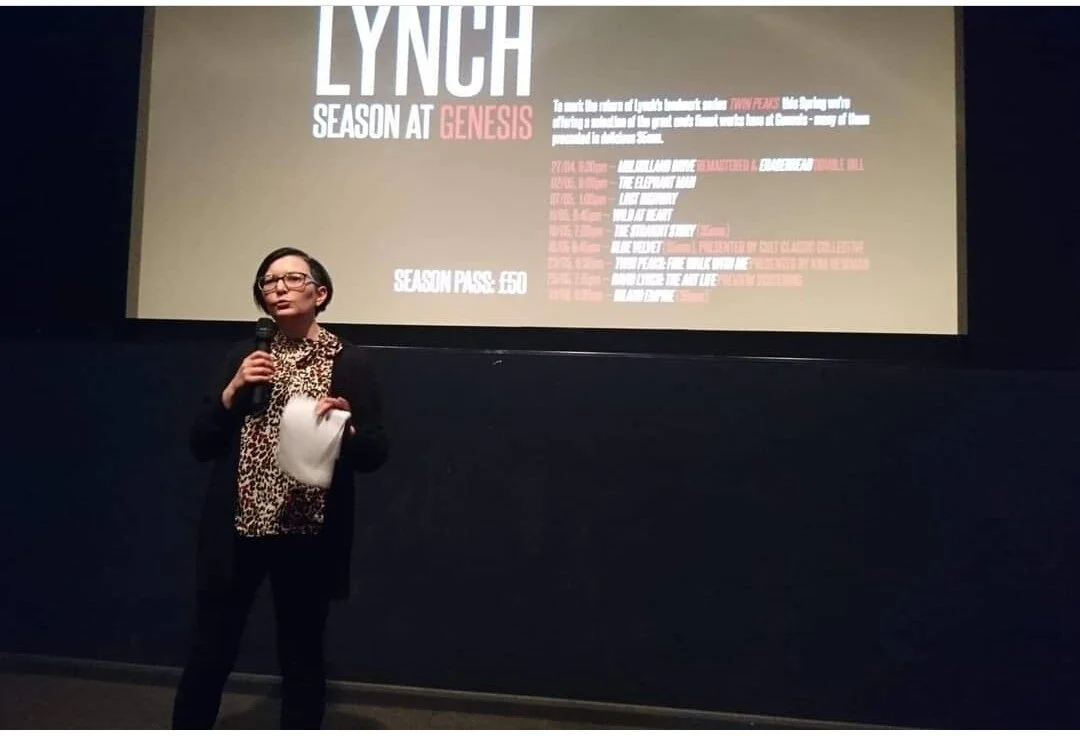
Dr Hallam speaking on David Lynch
What draws me to Lynch’s work is the mystery. He never solves things or gives clear-cut answers—things don’t make “sense” in a logical way, so you just have to surrender to it. Once you manage to do that, it becomes so rewarding; you can just get lost in it all and never come out of it. That he was able to do this on television in the early ’90s was groundbreaking, although there are earlier shows that also had that element of “weirdness”—I think for example of the 1960s British show The Prisoner—but Twin Peaks caught on in a way that captured the zeitgeist and became, for a moment at least, quite mainstream. In the second season Lynch and co-creator Mark Frost were pressured to solve the central mystery, which meant it lost its way a bit though. I think Lynch also lost some interest in it as well, so despite it not being sustainable, I do think it paved the way for shows like The X Files and Millennium, in that it showed that audiences really liked weirdness and mystery, and also (especially in the case of Millennium) that they were willing to go to some really dark, disturbing, and violent places. Now of course the majority of popular and prestigious television shows are practically required to go to those dark places! And I think you can chart that back to Twin Peaks.
Do the more dreamlike aspects of horror (movies like Mulholland Drive, Dario Argento's work, etc.) help viewers engage with their "shadow selves”? Is that part of what makes these stories so memorable?
I think there is absolutely that lure of the forbidden that I mentioned before, almost like a challenge to see how far you can go in terms of what you open yourself up to—but with the safety net of being able to then say to yourself, to quote a famous tagline, “It’s only a movie. It’s only a movie.”
The dreamlike aspect is central to this. I think we have all had dreams that have profoundly affected us, and a lot of it has to do with them not making sense. Not having a rational explanation makes them stick. They work on a visceral level, in images and beyond language. And cinema is the only medium that can get close to the experience of a dream. Certain directors do this well, Lynch obviously, as well as Luis Buñuel, and they are both thought of as “arthouse directors,” but horror directors also excel in this, especially the great Italian directors like Mario Bava and Dario Argento. From its opening shot Suspiria (1977) plunges you into a nightmare, but it is a seductive and beautiful one, again highlighting the lure of darkness.
In your research on found footage and desktop horror, how do you think these narratives continued to evolve with everyone stuck at home during the pandemic, relegated to using Zoom and similar platforms to communicate?
The desktop horror film started to emerge around 2014, with the release of films such as The Den, Open Windows, and Unfriended. Director/producer Timur Bekmambetov even came out with a manifesto of sorts, for what he called “screenmovies” or “screenlife movies”, where the computer screen became the film’s setting. I have argued that these films accurately express what it feels like to live right now, with so much of our lives played out on screens; our sense of identity, our emotions and our relationships are bound up with these devices.
But then only a few more of these films came out, and I was starting to wonder if it was a trend that had already run its course. Then last year happened, and in the midst of it all a wonderful film called Host, all set on Zoom, came out and I think it has rejuvenated the form.
It makes sense that horror filmmakers would explore the repercussions of our dependence on phones and technology, especially given that we had to completely rely on them as a lifeline, to be able to continue to work and maintain connections [with] each other during such a terrifying time. This is certainly something that can be exploited—and also something that can provide a cathartic release.
For those interested in learning more about David Lynch, and directors like Argento and Bava, what do you recommend for reading material?
One of the first books about film I ever purchased was Michel Chion’s book David Lynch, so it has a sentimental place for me, as it’s the starting point where I really began to delve deep into Lynch’s work. Martha P. Nochimson’s two books are the pinnacle of Lynchian scholarship, especially her second book David Lynch Swerves, which looks at these films from a completely new perspective, incorporating ideas relating to quantum physics with study of the Hindu Vedas, in a way that completely opens up his work in a way that is, in every way, mind-expanding. That Nochimson is able to discuss her ideas directly with Lynch himself also adds another dimension.
In regards to Twin Peaks, Andreas Halskov’s book TV Peaks is great in combining analysis with interviews with many key figures involved in the show. I was also proud to be a part of The Women of David Lynch book, edited by David Bushman and Scott Ryan, because it is such an eclectic collection bringing together so many different approaches. I was honoured to have written a book on Twin Peaks: Fire Walk with Me as part of the Devil’s Advocates series, which includes so many excellent volumes on seminal horror films.
I think Kier-La Janisse’s House of Psychotic Women is a masterpiece, fusing film analysis with personal experience in a way that perfectly captures how and why horror is so important to so many of us, as well as consolidating horror’s capacity to express an explicitly feminine form of madness and terror. Patricia MacCormack’s Cinesexuality is a book of philosophy, elucidating beautifully the deep, all-consuming connection with cinema. Immoral Tales by Cathal Tohill and Pete Tombs is a classic.
I love the work of Stephen Thrower, Tim Lucas, Kim Newman, and Alexandra Heller-Nicholas; they have all written some fantastic stuff on Italian horror (and just horror in general). Australian film critic Travis Johnson is an old friend of mine and he covers absolutely everything, not just horror, at his website Celluloid and Whiskey. I also love Diabolique Magazine, edited by Kat Ellinger. It has work that is just as vital and insightful as anything from academia.
Having said that, though, there are some academics working now who are also doing great work on horror. I encourage everyone to seek out the work of Stacey Abbott, Robin Means Coleman, Laura Mee, Alison Peirse, Alexia Kannas, Craig Ian Mann, Iain Robert Smith, Murray Leeder, Marcus Stiglegger, Austin Fisher, Mikel J. Koven, Johnny Walker, Bernice M. Murphy, and Xavier Aldana Reyes (to name just a few!).
Art of Darkness: The Cinema of Dario Argento, edited by Chris Gallant, was given to me as a present years ago and is a much-treasured possession. I have the hardcover version and not only is the content incredible, aesthetically it is absolutely beautiful. It’s published by FAB Press, who have brought out several books by the authors mentioned.
And finally, it’s great to see the depth of analysis you can get from essays and commentaries attached to Blu-Ray releases from distributors such as Arrow, Indicator, Second Sight, Severin Films and Vinegar Syndrome. Long live physical media!
This interview has been edited for length and clarity.
Interview by Laura Kemmerer
Laura tuned into horror with an interest in what these movies and books can tell us about ourselves and what societies fear. She is most interested in horror focused around the supernatural, folklore, the occult, Gothic themes, haunted media, landscape as a character, and hauntology (focusing on lost or broken futures).
