
The Entity (1982): Trauma and the Transgression of Spirits
Content Warning: Rape, sexual assault
Updated September 2026: The case that inspired The Entity has now been revisited in What Happened to Doris?, formerly titled Entity Within. Starring Heather Graham as Doris Bither, the film premieres at the 2026 Fantastic Fest.
Sidney Furie’s 1982 film The Entity was greeted by audiences with mixed reactions. Released to international audiences just months after Tobe Hooper’s more commercially successful Poltergeist, The Entity’s box office performance in the U.K. was marred by protests from women’s rights groups, who objected to the film’s controversial depictions of rape. Several months later in the U.S., the film was quietly released without much publicity from the studio. Even so, Furie’s film attracted a fair amount of attention—not least because this film, like The Amityville Horror (1979)before it, was based on a true, and well-documented, story.
My intention with this article is to introduce the text and its content as the beginning of a brief series, in which I look more closely at the two competing approaches to solving the desperate protagonist’s problem, in an attempt to determine whether the film is able to provide some insight into its volatile subject matter.
The film, and the novel it was based on, were both written by Frank De Felitta, known at the time as the author and screenwriter of Audrey Rose (1977). De Felitta was inspired by the 1974 case of Doris Bither who, along with her four children, was squatting in a condemned home in Culver City, California. Bither had reached out to Barry Taff, a local parapsychologist, with a bizarre tale of having been raped, multiple times, by an invisible assailant. Taff and his associate, Kerry Gaynor, accepted the case and though they did not seek to solve Bither’s alleged rape, they did claim to have found, over the course of their ten week investigation, significant evidence of poltergeist activity in the home.
The film follows the alleged events fairly closely, though some names and details were changed. It introduces viewers to Carla Moran (Barbara Hershey), a single mother of three, who, very shortly into the film, is assaulted by an unseen attacker. When she calls for help, her eldest, Billy (David Labiosa), races in to see what’s the matter. Carla shouts for him to find the invader but Billy reports back that all the doors and windows are closed and locked. No one else is in the house. A subsequent attack, however, forces the family out of their home and into Carla’s best friend Cindy’s living room.
These scenes, as well as the assaults that follow, can be difficult to watch. Hershey’s performance during the rape sequences is weighty and graphic, despite there not being an opposing actor to work against. Consequently, it is this performance that gives the film so much of its gravitas. What could have been a tasteless plot device that minimizes the experiences of many instead becomes a deeply unsettling premise that not only brings its subject matter to the forefront, but uses it as a platform from which to criticize the treatment of victims in the real world. Most importantly, however, The Entity re-contextualizes the fear of sexual assault by framing it—not as man vs. woman—but as human vs. inhuman.
This re-contextualization is critical in breaking down the barriers that exist in discussions about “rape culture,” a term which had only been introduced a few years prior to the film’s release and so hadn’t yet benefited from the ubiquity of the phrase as an awareness tool. The attacks on Carla Moran in The Entity come, not from a crazed maniac or ill-intentioned acquaintance, but from the titular spirit—a non-human, incorporeal entity that effectively doesn’t exist in the living realm. This distinction effectively short-circuits the defensive posture commonly taken by men in discussions about rape, who subconsciously project onto themselves the role of antagonist. If the offender isn’t human, though, then men needn’t be worried that the women in their lives secretly have them in mind when referring to their fears and unease.
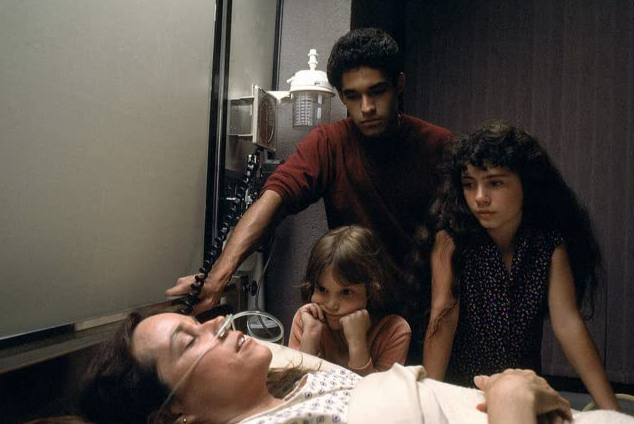
Carla’s three kids look over their mother in The Entity (1982).
Further, by shifting the focus from run-of-the-mill home invader to the paranormal variety, the film circumvents the seemingly default mantle of protection worn by male horror fans. There is no pretense that the man, in his own mind, would be able to fend off or outwit the villain, saving himself and (more importantly) the distressed damsel, normally a potential love interest. The male audience, as well as the female audience, are rendered helpless against the poltergeist, allowing the men to see themselves in Carla’s place—as victims, rather than potential saviors. Thus, not only are men disrupted from the emotional barricades they’ve become accustomed to erecting, but they are disarmed of their perceived heroism if put in a similar position as the characters on screen. Men are no more able to control their own fate than Carla Moran is as she’s attacked—in her bedroom, in the bath, or in her living room, while her hysterical children watch in horror.
In the next installment of this series, I plan on dissecting the clinical approach taken by Carla’s psychologist, Dr. Sneiderman (Ron Silver), who views her experiences as reconstructions of a childhood trauma. Then, I will look at the results-based method taken by the parapsychologists who take over when Carla loses faith in Sneiderman, before comparing the two and determining what, if anything, the text adds to our understanding of the treatment of trauma victims and how they are viewed in media—and by extension—society.
The Entity is a rich film that to this point, I believe, has not garnered the attention it deserves. I greatly encourage everyone to see it, content warnings allowing. It seems to have fallen into relative obscurity, save for some brief mentions, but its relevance has never, since its release, been out of the question.
Article written by Ande Thomas
Ande loves the intersection of sci-fi and horror, where our understanding of the natural world clashes with our fear of the new and unknown. He writes about monsters and foreign horror and can also be found over on Letterboxd.

Other articles you may enjoy…
Bones and roots adorn the walls of their dimly lit home. A mjölnir necklace hangs around K.’s neck as he hand carves incense into a small cauldron burner and a breathy soundtrack begins to play. This is a couple that is in tune—with themselves, with the natural world, and, as we will soon see, the supernatural world, as well.