A resurgence of Folk-Horror - Round Table Discussion of “Midsommar”

Largely billed as horror that takes place in broad daylight, Midsommar was director and screenwriter Ari Aster’s first heavy-hitting film following Hereditary. In Midsommar, a grieving Dani (Florence Pugh), mired in a troubled relationship with her boyfriend Christian (Jack Reynor), has the chance to go on a once-in-a-lifetime trip to Sweden for a midsummer festival that is anything but what it appears to be.
Laura Kemmerer: Director Ari Aster roughly summarized Midsommar as a break-up movie in folk horror clothing. So, I’ve seen some posit that the element of folk horror isn’t as strong as a result. I’m inclined to strongly disagree with this, because we get the traditional folk horror elements, but this is a very contemporary installation in the sub-genre.
Destiny Johnson: The first time seeing Midsommar, I loved that the film left me with the desire to know more. Not that Ari Aster didn’t cover enough, I simply needed to understand. From the opening mural to every piece of art for that matter. What stories are being told that we don’t see, that we don’t hear.
Ande Thomas: During the film’s initial release, many men found themselves identifying with certain characters, but the way these characters were so quickly and quietly killed off left them disturbed in a way that I wasn’t quite expecting. For me, the lens was very much focused on Dani. One of my favorite aspects of the movie, I think, is that depending on the point of view, it can be taken so differently. For Dani, it’s very much a fairy tale where she finds her place of belonging. For each of the other characters, you can see a classic folk horror/slasher narrative unfold.
LK: I think with Midsommar there is also the element of terror vs. horror. I know I’m probably at least partially misremembering these definitions, but as far as I understand it, terror is the fear leading up to a jump scare, for example, like involving the buildup, and horror is the revulsion that comes after seeing said disturbing thing. I think Midsommar plays on this rather strongly, as it holds up a personal mirror of what we find acceptable. Is suicide suddenly acceptable because it’s in a ritual context? In contrast, Hereditary worked more with that traditional definition of horror.
What do we feel worked in the movie? What didn’t?

AT: Pacing. For me, I think one of the biggest feats that Aster was able to manage was such a steady transition from trauma to healing. He doesn’t cut corners. We’re able to feel Dani’s entire journey as if it were our own, right? He doesn’t cut away from Dani’s tears or her depression or mania, and that attention is maintained all the way through to the conclusion. Even in the Director’s Cut, I got the sense that everything that had been cut for the Theatrical Release had been cut for time, not disruptions in the pace of the film. To be able to do that not once, but twice, is incredible.
LK: I agree with the point about pacing. The attention to detail in how the story was built also struck me as outstanding. We’re met at the beginning of the movie with the four-act structure of the story depicted in the mural, but even the rough art present acclimatizes us to the concept of folk art and by extension the concept of folk life (specifically the cult). I also thought that shots were extraordinarily well framed, from the face-down perspective of the drive to the compound to the camera gradually turning completely upside down. What we know of ourselves and the world no longer applies in going into the cult environment. I also have to give credit for casting Will Poulter as comedic relief—his jokes gave the movie the narrative breathing space I needed to genuinely enjoy it on first watch. Hereditary is still a movie I adore, but I lovingly call it a “wall of misery” for a reason.
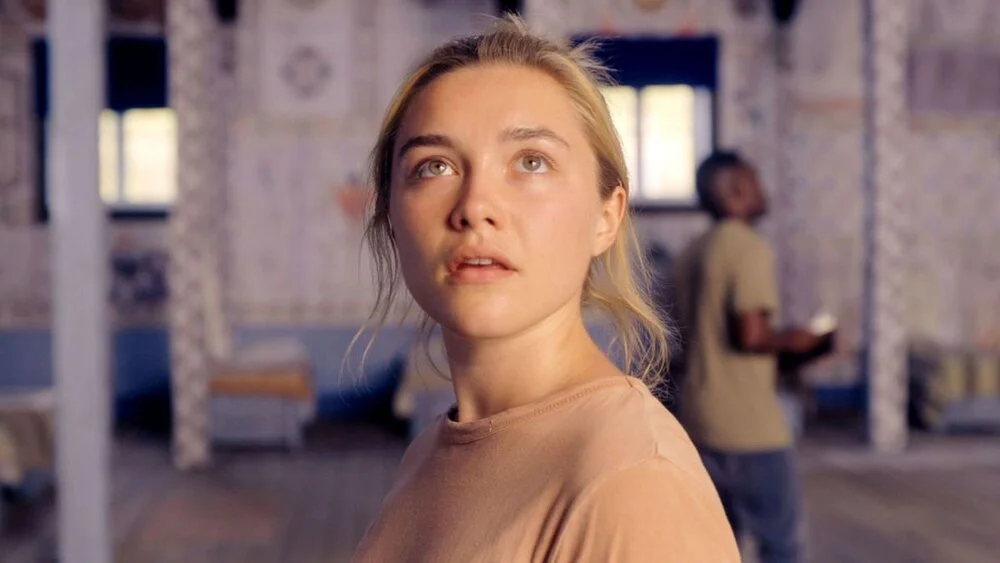
DJ: Yes, I also feel that this movie sort of held our hand as we were taken, unknowingly, to a place where certain horrors are accepted for ritualized holidays. However, Aster leaves us these hints of what is to come and prepares us, if we pay attention—or watch the movie three times and continue research FOR FUN! Like Laura said, the mural, the opening scene to the whole movie, gives us a quick view of the series of events about to unfold. If you weren’t able to pick that up the first time, the age group this movie focuses on, takes us through a regular routine. We feel comfortable and even trusting of Pelle (Vilhelm Blomgren). Everything that you would expect at a music festival appears to be normal: the jokes, the drug culture, tents and camping. Everyone is shown in that first day that this should be like any other festival experience they may have had or were made to believe.
AT: Will Poulter was great. I like the “wall of misery.” I think there’s a great contrast between Hereditary and Midsommar. Hereditary is brilliant at maintaining an almost unsustainable level of tension, whereas Midsommar keeps us at a lower level, disarming us with comedic moments but not at the expense of the tension. That lower level, though, makes the shocking moments that much more impactful.
I also love that point, Destiny, about the age group the movie focuses on; that’s something I never even considered, despite it being explicitly talked about. Obviously, Dani and her friends are at the age where a trip like this is possible, right? But the way that Hårga places an emphasis on “the four seasons” of life, I think plays a pretty significant role in how the story develops. Yes, it’s the same age that the cult members are expected to go out into the world and bring outsiders back, but I think there’s an important detail in this age group being dead in the middle of the “summer” age. I’m not sure yet what that is; I think it’ll take a few more views for me to grasp it.
DJ: YES. In comparing Midsommar and Hereditary, we are both getting that deeply researched context but in a dark vs. light setting. Ultimately, Hereditary gives us the jump scares and the continuous intensifying darkness. But in Midsommar, although we see very impactful scenes that teach us more about the cult, instead of watching Dani being dragged further down, we see her thrive after she let herself grieve.
Also, noting back on the age group points and “being dead in the middle of the ‘summer’ age,” maybe this has something to do with them being in the “prime of their life.” Dani turned 27 on the trip, an almost exact half-way mark through the Hårga defined lifetime. Given this is roughly the same point life for our main cast, women at this are under an outdated pressure to get married or bear children, while men are under pressure to bring something to the table, or in this particular story: have chosen an academic route and need to successfully express an anthropological thesis. There are desires and dreams at stake, it’s where adult life begins.
“I think it’s a societal shortcoming we have in our country, whereas Hårga is built around that sort of sharing of grief. ”
AT: How do you guys feel about how the film handled the themes of suicide? There’s an obvious contrast between the personal nature of Dani’s sister’s suicide, and the communal/ritual nature of the ättestupa.
(For context, the ättestupa is a name given to a number of precipices in Sweden where ritual senicide reportedly took place, though recent research indicates that this place name is based on an Icelandic saga that only dates back to the 17th century.)
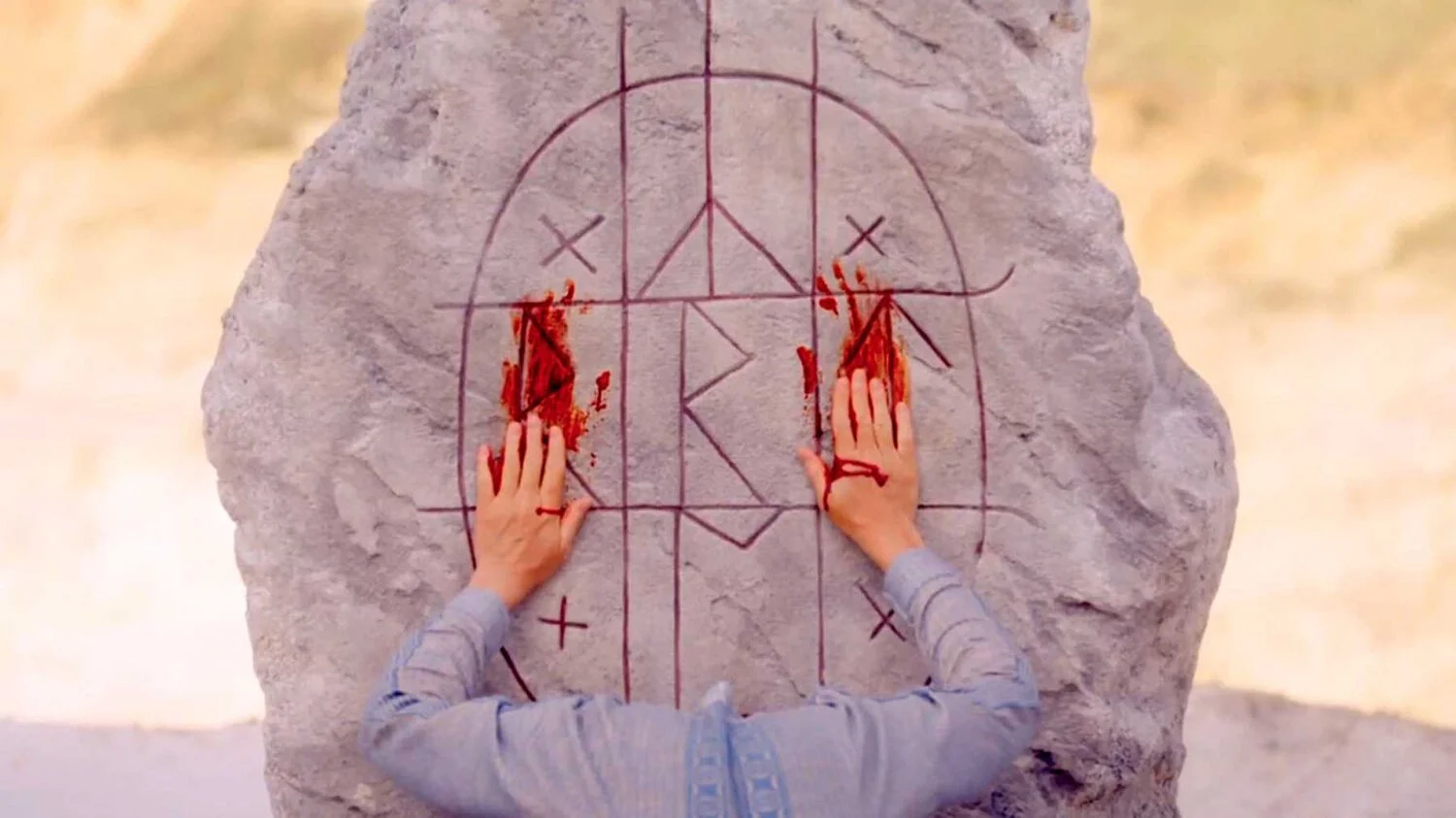
LK: What I took away from the contrast was, again, that element of the cultural mirror. The ättestupa is seemingly a byproduct of a cultural attitude that makes suicide sacred. In the eyes of the cult, these two elders have reached the end of their “useful” lives, and the dignified thing to do is essentially opt out. To die with dignity. There’s something very impersonal about how Dani’s sister died and took their parents with her, which also highlighted for me that element of collectivist vs. individualist societies. At least in the U.S., there is no real support for someone contending with the suicide of a loved one. In the cult, there is this attitude of carrying its members from birth until death, but this also means projecting the will of what is good for “the whole” vs. what is good for the individual.
AT: Absolutely. You can even see the lack of support in Christian’s response to Dani’s phone call—and unlike most of his responses in the movie, I don’t actually blame him for this. He is simply ill-equipped to handle a situation this grave and given his misgivings about their relationship at the time, he feels like he’s stuck between a rock and a hard place. I think it’s a societal shortcoming we have in our country, whereas Hårga is built around that sort of sharing of grief.
DJ: Call me a freak, but I was much less disturbed by the ättestupa practices in the cult than when seeing the murder/suicide conducted by Dani’s sister. To be taught to understand that this was the cult’s common practice and that those next in line were proud to take their own life, or have their life taken for them if the jump from the precipice was not successful, I just felt it was a natural part of their lifecycle. There was no “shock” like what is normally found in the wake of suicide, in fact, there is usually a lot of religious frowning down on the event or sometimes prevention awareness (moreso from friends and select family), coming from an American perspective.
AT: That’s a really great point. There is definitely a sort of hushing of suicide in American culture and I think there’s a downward pressure from the religious right. Suicide is viewed shamefully in our society, which doesn’t give survivors any outlet for their grief. It’s an issue that people want to solve but can’t even discuss it openly.
The ättestupa is a seriously triggering moment for Dani, who envisions her own parents dead at the base of the cliff. Whereas the commune will watch, feel their feelings, and move on, Dani is still dealing with her trauma months later. One of the commune members even says as much in the Director’s Cut after Christian asks her how many times they’ve seen that ceremony. “Oh, many times,” she says, without even breaking her smile.
LK: So, this contrast of ritual vs. an almost impersonal perspective on suicide reminds me of the concepts of wyrd and orlog in Anglo-Saxon culture. Succinctly put, the way the two intersect is basically the concept that you are fated to die, but how you meet that death is up to you. The elders participating in the ättestupa is a great example of this. In contrast, at least in the U.S., there is more dialogue around suicide, sure, but what winds up happening, again, is this kind of deferral of our responsibility to each other as people. To care, to engage with the grieving even if it makes us uncomfortable. We literally do not have cultural ideals that are even remotely comparable to wyrd and orlog, even to better understand/emotionally process suicide when it happens.
I would also point out that both instances of suicide heavily and dramatically impact how Dani relates with others and how she sees herself in the world.
“What stories are being told that we don’t see, that we don’t hear.”
DJ: Right, I mean to Dani, suicide wasn’t just her sister leaving this world, it was losing her entire family. Her shit boyfriend would rather go to parties than comfort her. Which is why I also agree that the ättestupa event was so triggering, causing her to grab Christian’s wrist, still getting no emotional support in return. I feel like for the first time, Dani is seeing death as a choice made together, a practice, not a tragedy that everyone feels guilty about. Everyone in the cult supports one another and no one is left to feel alone. Where we can sense and even see, that is very much the mental space Dani seems to be stuck in.
LK: Speaking on how these events hugely impact how we relate to each other and how we are in the world. This kind of concept of fate also seems to extend to Dani’s arrival to and participation in the cult. Pelle is honored for his “unclouded vision,” for example, as in he can see into the future of how Dani will impact the Hårga. Do you think Dani was fated to find the cult, or were there conditions of loss that had to be met first?
DJ: This is kind of tough for me, because I would like to say that Dani was meant to be May Queen and accepted into the cult from the gate. For basic movie hints, she’s our main character and whose perspective the story is told from. But, at the same time, the more I think about the need for her tragedies, I can’t help but feel it would negatively affect the movie if we didn’t have them. Pelle wouldn’t be able to connect with Dani prior to them going to Sweden, giving us the only ally Dani has, even if she didn’t know it yet.
article written by all of us

In The Buffalo Hunter Hunter, blood carries the violence of colonialism, while a settler’s journal controls whose story survives. This essay examines how Stephen Graham Jones uses vampirism and layered testimony to confront historical erasure.